

Singapore has one of the longest average working hours in Asia. Most professionals here spend upwards of eight to ten hours seated at a desk, commuting on the MRT, and winding down on the sofa before bed. Public health campaigns have long promoted the idea that hitting 10,000 steps a day is the antidote to a sedentary lifestyle. Whilst walking is genuinely beneficial for cardiovascular health, it does not address the structural and physiological damage that prolonged sitting inflicts on the body. That is where chair yoga becomes a serious conversation, not just a wellness trend.
Why Walking Alone Does Not Undo the Damage of Sitting
The human body was not designed for static, sustained flexion at the hips. When you sit for extended periods, several physiological changes begin to occur simultaneously, and most of them are invisible until they become painful or debilitating.
The hip flexors, particularly the iliopsoas muscle group, adaptively shorten. This is not something that gets reversed by walking, because walking does not bring the hip into full extension under load. The thoracic spine, the middle section of your back, rounds forward and loses its natural mobility. Over time, the surrounding muscles stop activating properly. The diaphragm, which sits just above the abdominal cavity, becomes compressed when you slump forward, reducing the efficiency of every breath you take.
Research published in occupational health journals has consistently shown that people who sit for more than six hours a day face elevated risks of type 2 diabetes, cardiovascular disease, and chronic musculoskeletal pain, even when they exercise regularly outside of work hours. This phenomenon is sometimes called the “active couch potato” paradox. You can run five kilometres every morning and still carry the physiological burden of a sedentary person if you spend the rest of the day seated.
What Is Happening Inside Your Body During a Sitting Day
Understanding the mechanics helps explain why conventional exercise falls short.
Anterior pelvic tilt and lumbar loading
When the hip flexors shorten, the pelvis tilts forward. This increases the curvature of the lumbar spine and compresses the posterior elements of the lower back discs. Over months and years, this contributes to disc degeneration, nerve impingement, and the kind of chronic lower back pain that sends millions of Singaporeans to physiotherapy or orthopaedic clinics.
Thoracic kyphosis and shoulder dysfunction
Prolonged forward head posture and rounded upper back reshape the resting tone of the muscles around the shoulder girdle. The pectorals tighten, the rhomboids and lower trapezius weaken, and the shoulder blades lose their ability to move freely. This often manifests as persistent neck stiffness, upper back aching, and shoulder impingement.
Diaphragm compression and shallow breathing
When you sit slumped, your diaphragm has less room to descend during inhalation. The body compensates by recruiting accessory breathing muscles in the neck and upper chest, which leads to a pattern of shallow, upper chest breathing. This chronically activates the sympathetic nervous system, keeping your body in a low-grade stress state throughout the working day.
Reduced venous return and ankle oedema
Prolonged sitting slows the venous return of blood from the lower limbs. Many desk workers in Singapore notice ankle swelling and leg heaviness by late afternoon. This is not just discomfort. Chronic venous stasis is a contributing factor in deep vein thrombosis risk, particularly on long-haul flights after already sedentary work weeks.
Why 10,000 Steps Cannot Fix These Problems
Walking is a repetitive, sagittal plane movement. It primarily engages the hip extensors and flexors in a shortened, forward-stepping pattern. It does not meaningfully lengthen the psoas under load. It does not restore thoracic rotation. It does not retrain the diaphragm to drop fully during inhalation. It does not decompress the lumbar spine.
This is not a critique of walking. Walking is excellent medicine for general circulation, mood regulation, and metabolic health. The point is that it targets different problems than the ones created by sustained sitting.
What the sitting-damaged body actually needs is targeted, controlled mobility work that directly addresses the tight structures and weak neuromuscular patterns created by hours in a chair. It needs movements that open the hip flexors, restore thoracic rotation, retrain the breath, and decompress the spine without placing heavy loads on already compromised joints.
How Chair Yoga Addresses the Structural Damage Directly
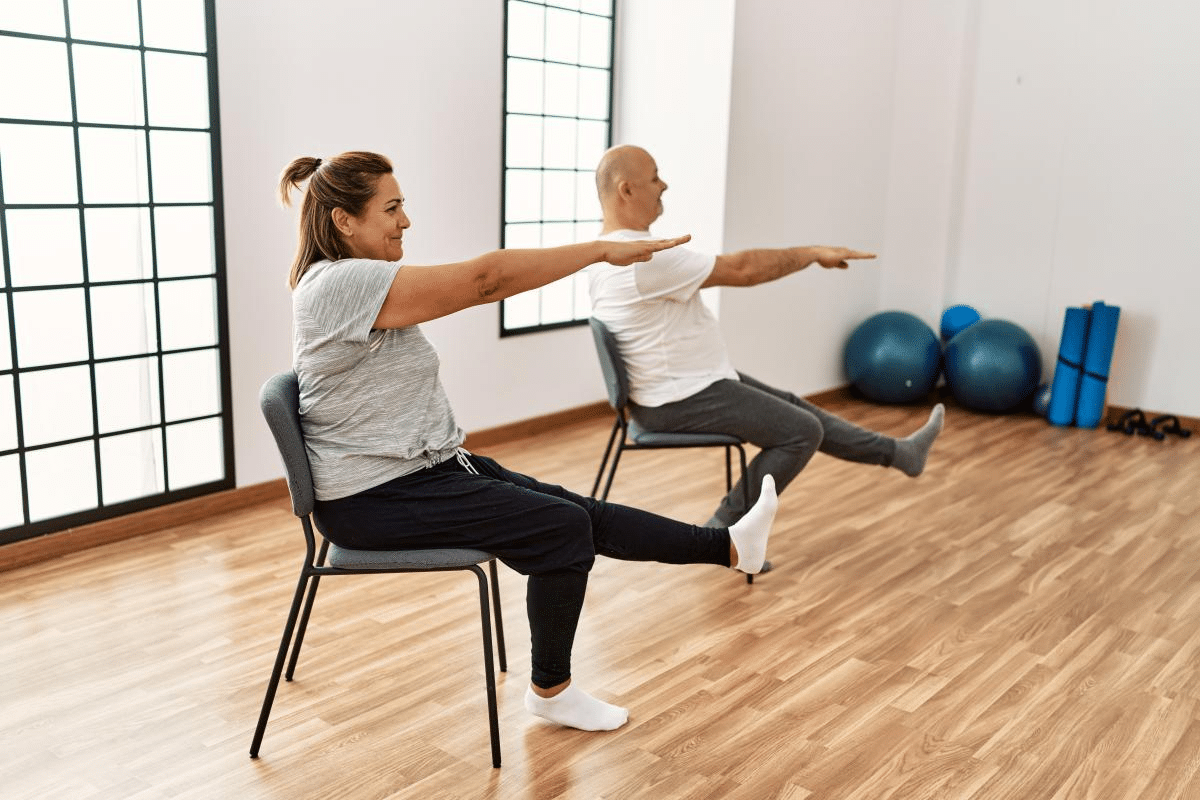
Chair yoga is uniquely positioned to address the sitting epidemic because it works within the environment where the damage originates. The movements are performed in or around a chair, making them accessible to people across all fitness levels and mobility ranges.
Seated Cat-Cow restores spinal segmental mobility
This movement cycles the spine between flexion and extension in a controlled, supported manner. It reactivates the small stabilising muscles along the vertebral column and begins to reverse the resting compression pattern in the lumbar and thoracic regions.
Chair Pigeon opens the hip rotators and stretches the piriformis
This is one of the most targeted hip openers available in a seated position. It directly addresses the external hip rotator tightness that develops in people who sit cross-legged or in a fixed neutral position for long periods.
Chair Twist restores thoracic rotation
Rotation is the first movement lost with thoracic stiffness and the last to be trained in conventional gym work. Seated twists gently mobilise the thoracic facet joints and lengthen the paraspinal muscles on the contralateral side. Regular practice significantly reduces upper back stiffness.
Pranayama in a supported seated position retrains the diaphragm
Seated breathing exercises, particularly diaphragmatic breathing and extended exhalation techniques, directly address the shallow breathing pattern caused by prolonged slumping. Within a few weeks of consistent practice, many practitioners notice improved breath depth, reduced tension in the neck, and a measurable improvement in their stress response.
Chair Downward Dog lengthens the thoracic spine and shoulder girdle
Using the chair as a prop allows the upper back to decompress without requiring the wrist strength or shoulder stability needed for a full floor-based Downward Dog. This makes it accessible to people who have never practised yoga before.
The Singapore Workplace Context
The challenge in Singapore is that the culture of long hours is deeply embedded. Many professionals feel that taking breaks during the workday is unproductive or even frowned upon. This is where the accessibility of chair yoga makes a meaningful difference.
A ten to fifteen minute chair yoga sequence can be performed at a workstation, in a meeting room, or during a lunch break without requiring a change of clothes, a yoga mat, or any equipment. The barrier to entry is genuinely low. For someone experiencing chronic stiffness, fatigue, or lower back discomfort as a result of desk work, this form of practice offers a pathway to relief that does not demand a trip to the gym or a complete lifestyle overhaul.
The compounding effect is also worth noting. Unlike a post-work gym session that addresses cardiovascular fitness in isolation, chair yoga performed at intervals throughout the day keeps the body moving through its full range of motion during the hours when stiffness is actually developing. This approach targets the root cause rather than attempting to compensate for it at the end of the day.
Building a Sustainable Practice
Consistency outweighs intensity in any mobility-focused practice. A ten-minute sequence performed three to four times a week will deliver more meaningful structural change than an infrequent intensive session.
The progression in chair yoga is also well designed for those returning to movement after long periods of inactivity. Poses can be modified to suit individual limitations. Breath work can be introduced gradually. Over time, practitioners often find that they naturally begin to sit with better posture, take fuller breaths, and experience less end-of-day fatigue, not because they have been told to correct their posture, but because the underlying tightness that was pulling them into poor alignment has been addressed.
For Singaporeans dealing with the cumulative effects of years of desk work, this is a practice worth taking seriously, not as a soft supplement to real exercise, but as a targeted therapeutic modality that addresses exactly the problems that other forms of movement leave untouched.
If you are ready to address the structural effects of Singapore’s sitting culture, Yoga Edition offers structured chair yoga classes suitable for all levels, designed to help you move better, breathe better, and feel better in your daily life.
Frequently Asked Questions
Q: Can chair yoga really reverse the effects of years of sitting, or does it only help prevent further damage?
A: Chair yoga can genuinely reverse many of the postural and mobility changes caused by prolonged sitting, though the timeline depends on how long the patterns have been established and how consistently you practise. Shortened hip flexors, reduced thoracic rotation, and shallow breathing patterns are all adaptive changes, which means the body adopted them in response to its environment. Consistent mobility work, even in short sessions, signals the body to re-adapt. Many practitioners notice meaningful improvements in posture, breath depth, and pain levels within four to six weeks of regular practice.
Q: Is there any point doing chair yoga at my desk if my office is open plan and I feel self-conscious?
A: Absolutely. Many chair yoga movements are subtle enough to perform without drawing attention. Seated Cat-Cow, ankle circles, seated spinal twists, and diaphragmatic breathing can all be done quietly at a workstation. Even five minutes of targeted breath work between meetings can meaningfully shift your nervous system state and reduce accumulated tension. You do not need a mat, props, or even much space.
Q: How is chair yoga different from just doing regular stretches at my desk?
A: The key differences are structure, breath integration, and sequencing. Ad hoc desk stretches typically address surface-level tightness without systematically working through the deeper structural patterns. Chair yoga sequences are designed to address multiple interconnected systems simultaneously, combining spinal mobility, hip opening, shoulder release, and breath retraining in a logical progression. The pranayama component in particular is rarely present in typical office stretching routines, yet it has some of the most significant effects on nervous system regulation and posture.
Q: I have a herniated disc. Is chair yoga safe for me?
A: Many people with herniated discs practise chair yoga safely and find significant relief, but you should get clearance from your physiotherapist or doctor before starting, particularly if you are in an acute pain phase. Once cleared, chair yoga is often recommended precisely because it avoids high-load spinal positions and allows for careful, progressive mobility work. Inform your instructor about your condition so that appropriate modifications can be made.
Q: How long before I start noticing a real difference in how my body feels?
A: Most practitioners notice some immediate effect on breath depth and acute muscle tension relief after their first session. Meaningful postural changes and reductions in chronic stiffness typically become noticeable within three to six weeks of consistent practice. Deeper structural changes, such as improved hip flexor length and restored thoracic mobility, generally develop over two to three months of regular attendance.
